


News
| Announcements

What is a marketing flywheel
and why your business needs one

Jet engine turbine viewed head on

Your marketing channels are working. They are just not working together.

A marketing flywheel fixes that by turning isolated campaigns into an integrated system where each channel strengthens the others, creating growth that compounds rather than resets every quarter.

A lone figure standing in an open field

You have Google Ads running. Maybe some SEO in the background. A social presence that gets updated when there is time. The results are not terrible, but they are not compounding either.

Each quarter feels like you are starting the push from scratch, spending the same budget, generating roughly the same leads, and wondering why growth is not accelerating the way you expected it to by now.

Each channel is running in parallel rather than with the others. That single issue is the difference between marketing that grinds and marketing that compounds.

What is a marketing flywheel?

A system where each channel strengthens the others, creating compounding growth rather than isolated results.
Floating disc form on a white background

The opposite of a flywheel is a campaign model. In a campaign model, every marketing effort essentially starts from zero.

You run a Google Ads campaign, it generates some leads, the campaign ends or the budget runs out, and the momentum disappears. Next quarter, you start again. There is no carry-over effect. No compounding. Just a cycle of spending and restarting.

Polished chrome mechanical component viewed from above

Here is what a connected system looks like in practice:

  • Paid search shows which messages and terms actually convert
  • Those terms shape the content built for organic search
  • Content ranks and brings in buyers without a cost per click
  • Returning visitors are retargeted with a relevant offer
  • Clients leave reviews and case studies that lift conversion everywhere
Each component makes the others more effective. That is a flywheel, and once it is moving it takes far less effort to keep it turning.
The gap
Why most businesses run campaigns instead of systems

If the flywheel makes sense, the obvious question is why most businesses are not already operating this way. Usually for three reasons:

  • Most agencies are structured around services, not systems. Each team optimises for its own metrics. Nobody is responsible for making the channels work together, because that is not what anyone was hired to do.
  • Most founders are managing short-term pressures. When leads slow down, the instinct is to turn up the ad spend. Reactive decisions, not strategic ones.
  • Integrated thinking is harder to sell and harder to report on. A campaign has a clear start, end and set of metrics. A system takes longer to build and requires a different kind of trust.

The integration gap sits in the space between agency briefs. We go through the symptoms in detail in why your marketing isn’t working together.

The result is a collection of marketing activities that each perform at a fraction of what they could if they were connected.

The payoff

What happens when the flywheel gets moving

A flywheel does not produce dramatic results in the first 30 days. The early stages often feel slower than running campaigns, because you are investing in infrastructure rather than immediate output. But the compounding effect is real.
What changes over time
01.
Organic traffic reduces your dependence on paid media, so budget goes further
02.
Case studies and testimonials lift conversion rates on the traffic you already have
03.
Referrals bring in clients already aligned with your offer, shortening sales cycles
04.
Acquisition costs fall as the brand becomes recognised in its market
05.
Each outcome feeds back into the system and makes everything else more effective
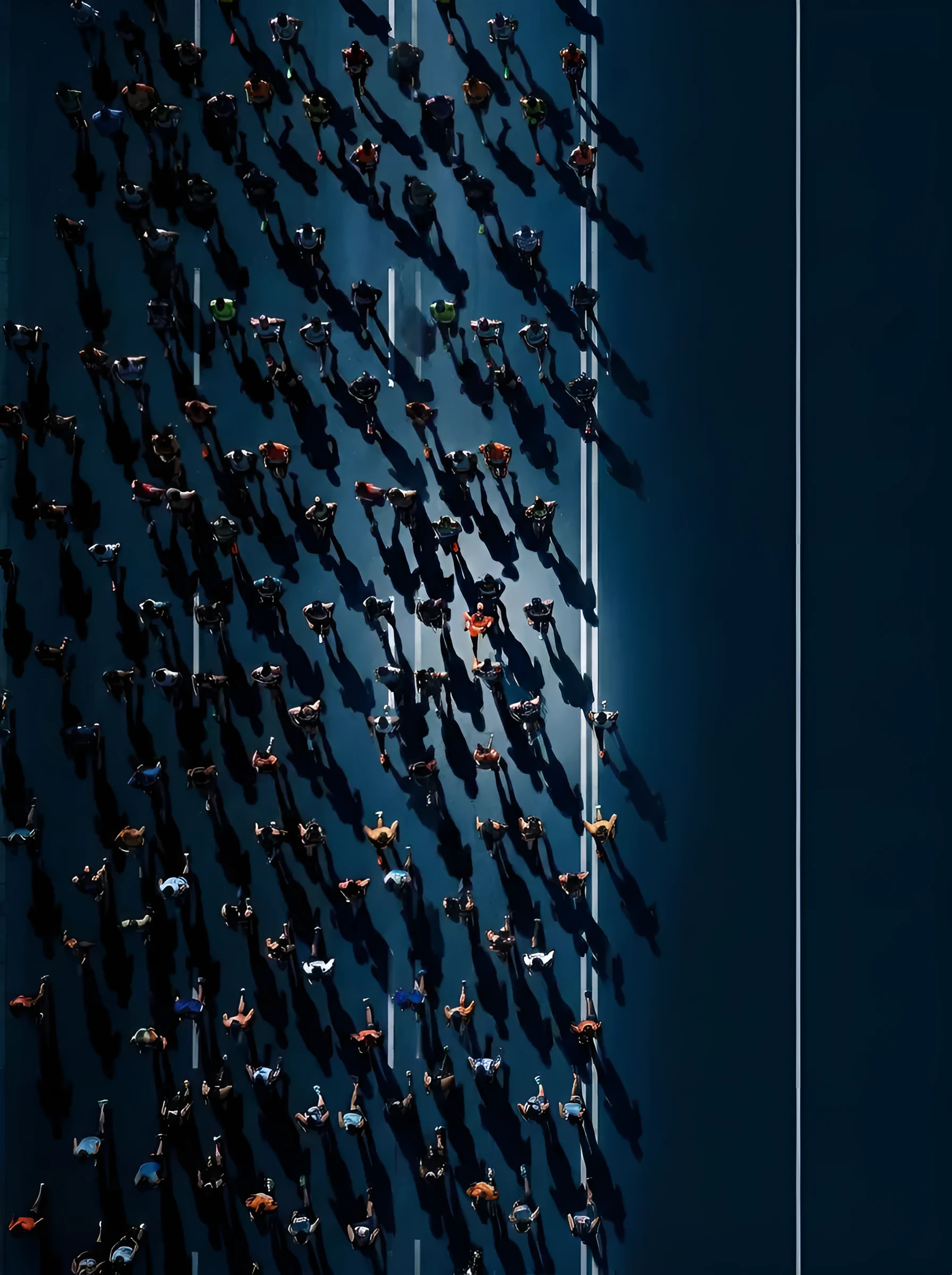
Aerial view of a large crowd of runners moving together

Kelvinaire, a Melbourne air conditioning business, shows what this looks like in practice. Paid search carried immediate demand, converting at 15.1% against an industry benchmark of 2 to 4%, while more than 30 suburb and equipment pages built the organic asset behind it.

Within a year organic users grew from 211 to 489 and organic engagement overtook paid as the site’s most active channel. Together the two now produce around 61 qualified leads a month. Read the Kelvinaire case study.


One connected system outperforms five channels working alone.
Two models
Campaign model vs flywheel model

The same budget, the same channels, two completely different outcomes over twelve months.

A campaign model/Every effort starts from zero/Momentum disappears when budget stops/Channels compete for the same budget/Each quarter resets the push/Results are linear at best
A flywheel model/Every effort builds on the last/Assets keep working after spend pauses/Channels feed each other data and demand/Each quarter starts further ahead/Results compound
Campaign results stop when the spend stops.
Flywheel results keep building, because every asset keeps working after it has been paid for.
The build

The four components of a flywheel that works

Every business’s flywheel looks slightly different depending on their model, market and growth stage. But the underlying components are consistent.

1. Traffic generation

Paid media and organic search. The flywheel approach does not replace either channel, it changes how they relate. Paid data reveals which messages resonate, informing the organic strategy. Organic builds authority, which warms the audience before they see an ad and lowers cost per acquisition over time.

2. Content and authority

Content is the connective tissue. It makes paid traffic worth clicking, earns organic rankings, nurtures leads who are not ready, and gives your sales conversation something to reference. But only when built with intention around the questions your ideal client actually has.

3. Lead nurturing and conversion

Most people who encounter your brand are not ready to buy. Email sequences, retargeting and well-built landing pages form a deliberate path from first encounter to the point where reaching out feels obvious. When this works, you stop spending the first meeting explaining what you do.

4. Retention and referral

The most underestimated part, and often the most powerful. Reviews strengthen local search and lift the click-through rate on your ads. Referrals bring pre-sold leads who convert faster. Case studies lift conversion everywhere. Treated deliberately rather than as a side effect of good service, this is where acquisition cost starts to fall.

The goal is not to do more of each. It is to make each one stronger because of the others.
Readiness
Is your business ready for a flywheel?

Not every business is at the right stage to shift from campaigns to systems. Here is an honest way to assess where you are.

You are probably ready if/Your core offer is proven and clients can speak to results/You have marketing in place and want it working harder/You are thinking about the next 12 to 24 months/You are willing to invest in something that compounds
You are probably not ready if/You are still testing whether the offer has market fit/You need leads urgently and cannot think past this quarter/Every dollar needs an immediate attributable return/There is nobody to own the strategic layer
The flywheel is a growth infrastructure decision, not an emergency response. If the first list fits better than the second, the next question is whether your current setup is built to deliver it.
The decision
Lone figure walking across sculpted green hills

Building a system that compounds

Most businesses reach a point where the campaign model stops working as well as it used to. Ad costs rise. Organic reach gets harder to hold. Results flatten, and optimising individual channels no longer moves the needle the way it once did.

A marketing flywheel is a decision to build something that gets stronger over time, rather than something that restarts every quarter. We walk through the four elements in practice in how to build a marketing system that compounds.

For founders who are serious about scaling, it is one of the most important strategic decisions they will make.

Ready to build a flywheel instead of another campaign?

Tell us where the business is heading and we will map what a connected marketing system looks like for it.
Start a project